


Overview of ÖSD - The globally prestigious German language certificate
Overview of ÖSD – The globally prestigious German language certificate
-
December 3, 2025
- Posted by: Hong Hanh
In the journey of learning German, choosing a prestigious international certificate plays an important role in studying abroad, applying for a job or settling down. Among them, ÖSD (Österreichisches Sprachdiplom Deutsch) is a certificate trusted by many businesses and schools. The following article will help you understand the ÖSD certificate and answer the question: "Is the ÖSD exam difficult?".
Overview of the ÖSD certificate
ÖSD is a German language proficiency certification system established by the Austrian Association for the Assessment of German Languages ÖSD. This certificate is based on the Common European Framework of Reference for Languages (CEFR), covering levels from A1 to C2.
Today, more than 100,000 candidates worldwide take the ÖSD exams each year at over 400 licensed test centers. For its outstanding contributions to the teaching and assessment of German language proficiency, ÖSD was awarded the “European Label for Innovative Projects in Language Teaching and Learning” by the European Commission in 1998.
The ÖSD certification is widely recognized for many important applications:
- Study abroad: Meets the entry requirements of many prestigious universities, colleges and academies in Germany, Austria, Switzerland and many German-speaking countries.
- Job: Opens up career opportunities in international companies, especially in the fields of nursing, engineering, services and healthcare.
- Legal procedures: Support for visa, work permit or residence application.
ÖSD German language certificate is always highly appreciated by German schools and businesses.
Since 2019, almost all ÖSD exams are modular, meaning that the exam modules (depending on the exam there will be two or four modules) can be taken independently at different times.
Some exams consist of 2 modules: Writing (including Reading – Listening – Writing) and Speaking. The 4-module exam applies to ÖSD Zertifikat B1 and ÖSD Zertifikat C2, including: Reading – Listening – Writing – Speaking.
ÖSD exams are held in both traditional (paper-based) and digital (computer-based) formats.
About the ÖSD Zertifikat B1 exam
The Zertifikat B1 exam is a joint product of the ÖSD, the Goethe-Institut (GI) and the Centre for Academic & Research at the University of Fribourg/Switzerland and is administered worldwide by both the ÖSD and the Goethe-Institut. At the ÖSD, the exam is officially called the ÖSD Zertifikat B1.
ÖSD Zertifikat B1 is one of the exams chosen by many students in Vietnam because of its relevance and wide recognition, as well as requiring candidates to have real German language ability.
ÖSD B1 exam structure
The ÖSD B1 exam is conducted in the form of 4 modules: Reading - Listening - Writing - Speaking, the specific content of the modules is as follows.
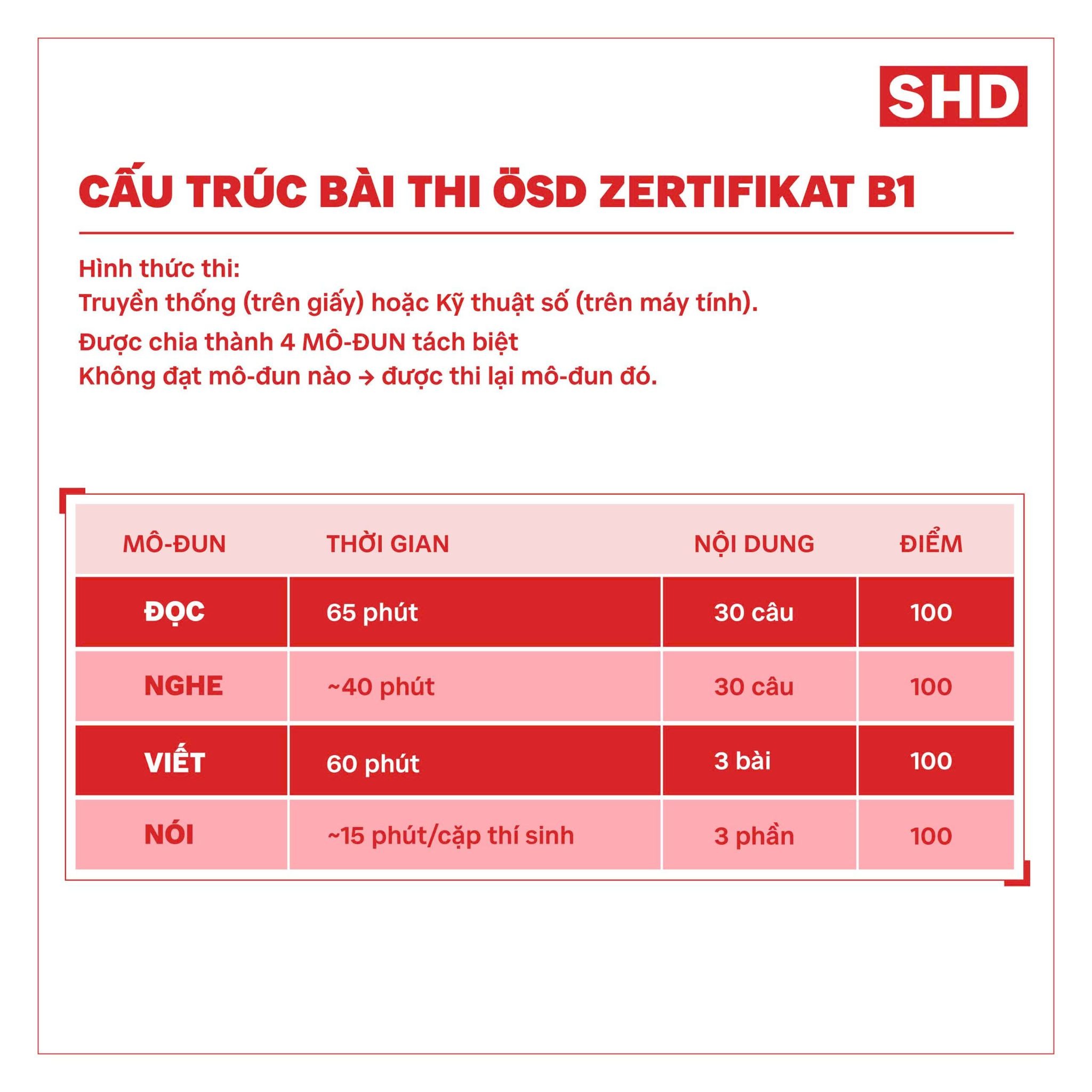
ÖSD Zertifikat B1 exam structure
| MODULE | TIME | CONTENT | POINT | |
| Read a short paragraph (article, email or blog) and answer questions. | 65 minutes | 30 sentences | 100 | |
| Part 1 | 1 reading passage + 6 true/false questions | |||
| Part 2 | 2 reading passages + 6 questions, choose A, B or C | |||
| Part 3 | 10 Ads and 7 Scenarios (Which Ad Is Right?) | |||
| Part 4 | 7 comments on a topic + 7 true/false questions | |||
| Part 5 | 1 reading passage + 4 questions, choose A, B or C | |||
| LISTEN | ~40 minutes | 30 sentences | 100 | |
| Part 1 | 5 listening passages + 5 true/false questions and 5 A, B or C questions | |||
| Part 2 | 1 listening passage + 5 questions, choose A, B or C | |||
| Part 3 | 1 listening passage + 7 true/false questions | |||
| Part 4 | 1 listening passage + 8 questions choose A, B or C (Who said what?) | |||
| Write an email/letter of personal nature (about 80 words). | 60 minutes | 3 lessons | 100 | |
| Part 1 | Write a friendly letter/email | |||
| Part 2 | Write a comment | |||
| Part 3 | Write a formal/semi-formal letter/email | |||
| SPEAK | ~15 minutes/pair of candidates | 3 parts | 100 | |
| Part 1 | Let's make a plan together | |||
| Part 2 | Brief presentation on an everyday topic | |||
| Part 3 | Briefly discuss your opponent's presentation and your own | |||
The Reading, Listening, Writing and Speaking modules will be marked completely separately. If a candidate fails one or more modules in an exam, they can still retake that module in subsequent exams.
For each module passed, the candidate will receive a certificate. When all modules are passed, the candidate can receive a total certificate, which shows all the results of the modules.
The maximum score for each module is 100 points and will be divided into the following rating scales:
| Point | Ranking |
| 100-90 | Excellent – Excellent |
| 89-80 | Gut – Good |
| 79-70 | Befriedigend – Quite |
| 69-60 | Ausreichend – Achieved |
| 59-0 | Not good enough – Not good enough |
Why is the ÖSD certificate highly valued?
In short, ÖSD is not a “trick” exam but a measure of the ability to use German in life and work. To achieve this certificate, candidates must have real ability: rich vocabulary, solid grammar, communication reflexes and critical thinking. These requirements make ÖSD trusted by employers and educational institutions in Europe.
Reference: Improve specialized German B2 level, helping students reach German business standards
Can't "learn by heart" - wide question bank, diverse exam questions
ÖSD builds a rich question bank, covering many topics of life, career and society. Therefore, candidates cannot just memorize a set of sample questions and still do well. This reality forces learners to practice flexible language skills, exposed to many different types of texts and communication contexts. For employers, that means an ÖSD certificate reflects real communication skills, not just achievements on paper.
Requires a rich vocabulary – from everyday to professional
To do well in the Reading, Listening, Writing and Speaking sections, candidates need a diverse vocabulary: everyday words, communication in the working environment, to vocabulary related to social topics. This vocabulary helps candidates quickly understand professional documents, participate in discussions and handle work situations - abilities that are highly appreciated by German businesses when recruiting Azubi or international personnel.
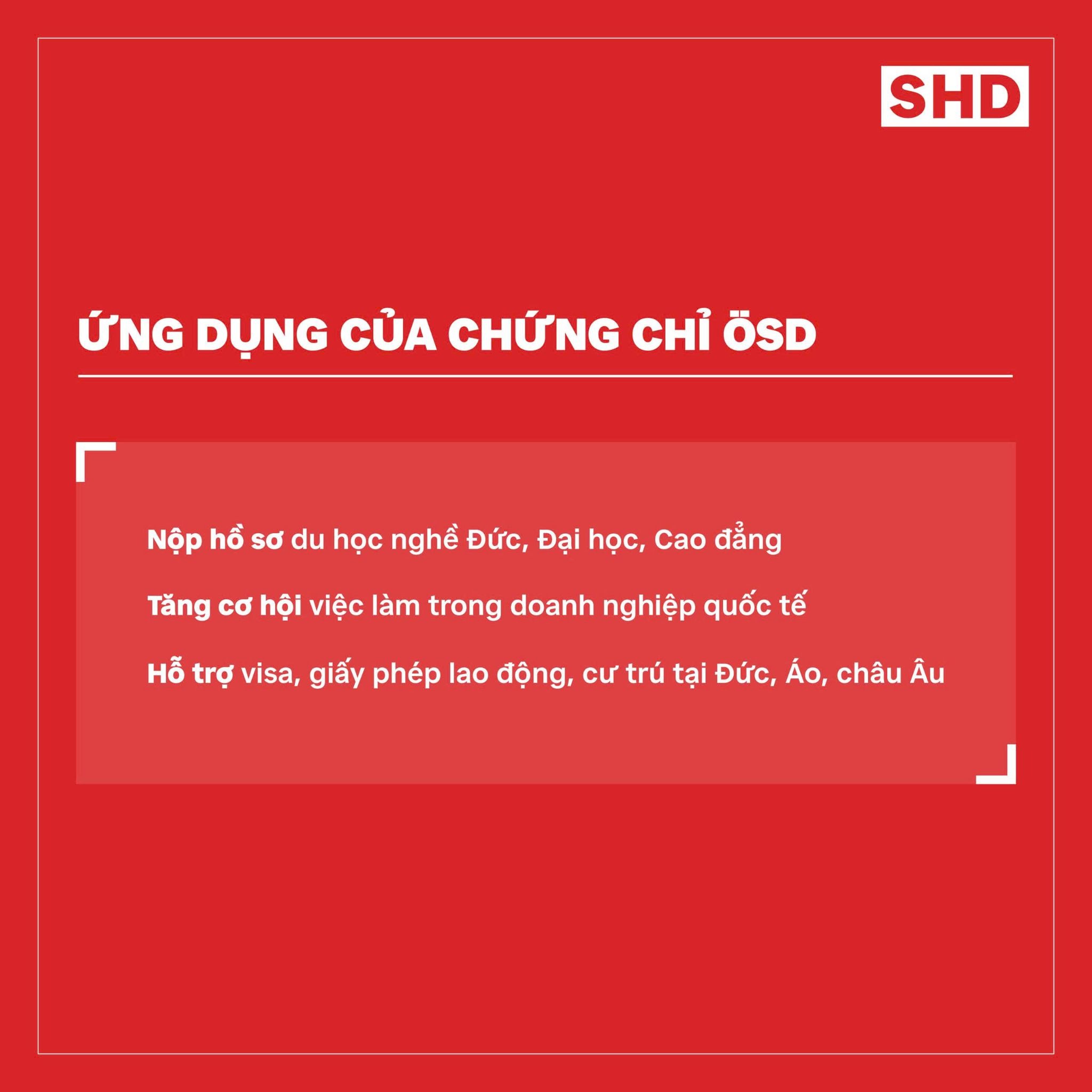
ÖSD certificate is used to apply for studying abroad, expanding international job opportunities.
Flexible use of grammar
ÖSD does not only test pure grammar knowledge but also requires candidates to apply grammar to express ideas clearly, especially in the Writing and Speaking sections. The ability to use appropriate structures to explain, compare, argue or describe work processes is a measure of professional communication ability. For employers, employees with “solid and flexible” grammar will reduce specialized language training time and integrate faster.
Promote critical thinking
The ÖSD writing and speaking/presentation sections require candidates to not only state their opinions but also to analyse, reason and present their views clearly. Critical thinking helps candidates to deal with complex situations, make suggestions or give professional feedback – skills that are essential in a professional working environment. Therefore, ÖSD graduates are often assessed as having the ability to think independently and communicate effectively at work.
Advantages of taking the ÖSD Zertifikat B1 exam
In Vietnam, the ÖSD Zertifikat B1 exam is held at reputable testing centers, creating favorable conditions for candidates to practice and take the exam systematically, while ensuring that the certificate is widely recognized and meets practical German language requirements.
Convenient test location
Currently, ÖSD Zertifikat B1 exams are held at three authorized centers in Ho Chi Minh City, including: Ho Chi Minh City University of Social Sciences and Humanities, Phuong Nam Education, Deutsch Campus.
With these locations, candidates in the South can save on travel and accommodation costs, and easily arrange time to take the exam.
Flexible and regular exam schedule
The ÖSD exam is held periodically about every 2 months, helping candidates to be proactive in registering and reviewing. An exam can have up to 300 candidates, suitable for the large demand of German learners in Vietnam. In addition, during peak periods or according to actual needs, centers can organize additional exam sessions, ensuring to meet the large number of German learners in Vietnam.
High quality certificates, suitable for German business requirements
In particular, ÖSD B1 certificates are highly appreciated by German businesses, especially in the healthcare industry such as Nursing and Dental Assistant.
This is because the ÖSD exam requires practical competence: candidates must understand, analyse and express information in professional situations, ensuring practical communication skills and not just relying on theory.
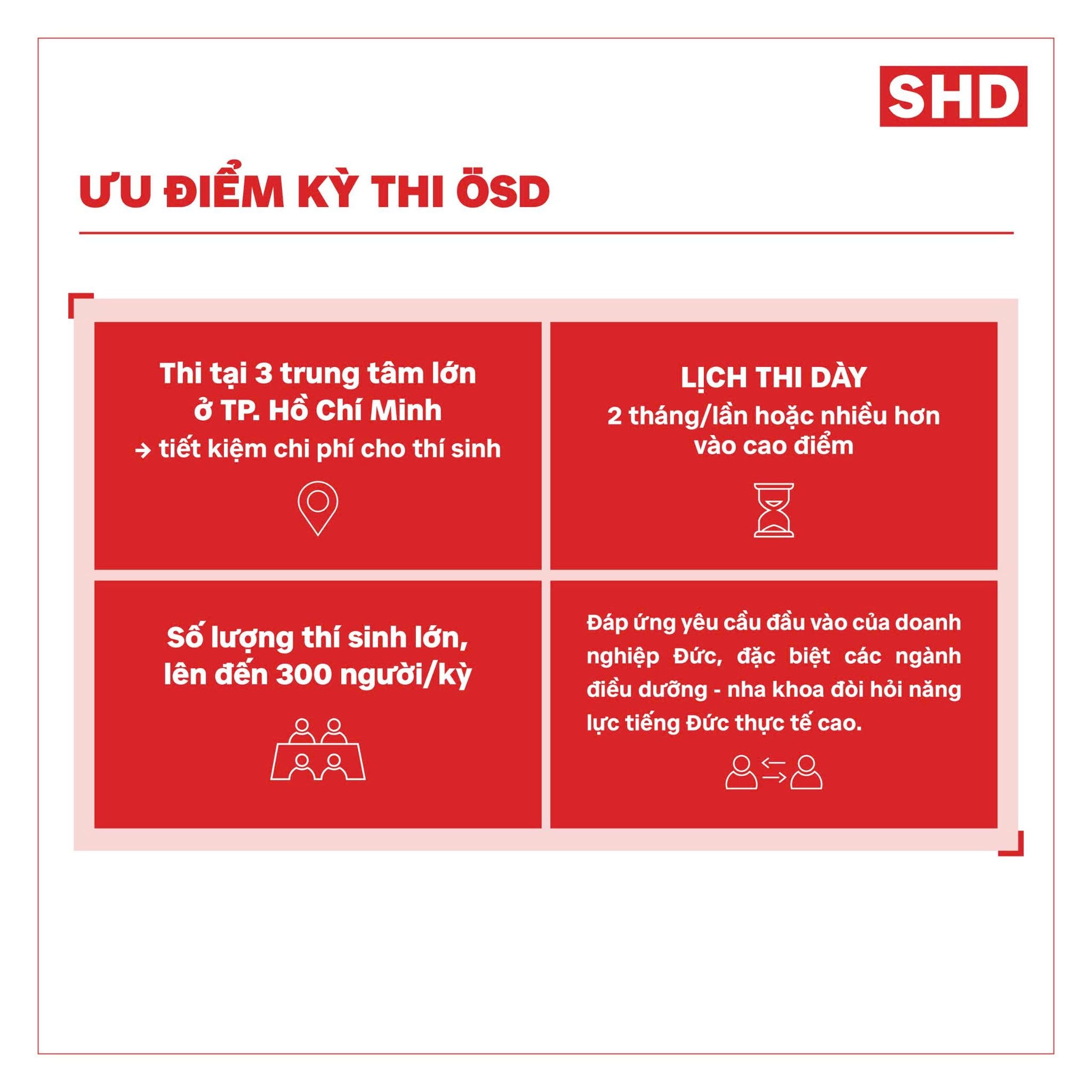
The ÖSD exam is increasingly popular in Vietnam.
SHD has a team of specialized test preparation instructors.
At SHD, students receive comprehensive support thanks to:
- Experienced faculty, well-versed in exam structure and requirements
- Guide to effective test preparation strategies for each skill
- Direct professional support from ÖSD examiners
With a rich system of review materials, students can access a variety of books and reference materials, from basic to advanced, to strengthen all four skills: Reading, Listening, Writing and Speaking.
Thanks to that, students not only understand the requirements of each module correctly, but also improve their practical ability, increase the pass rate on the first attempt, and develop the ability to use German flexibly at work.
ÖSD Exam – A reliable choice for your German language journey
For students who are preparing At the orientation, the SHD student reception and management team provided useful and specific information about:, especially in the healthcare industry - where communication skills and high problem-solving skills are required, ÖSD clearly demonstrates its advantages:
- Realistic exam, accurate assessment of ability
- Candidates with an ÖSD diploma are often more confident when interviewing with German companies.
- German language ability after taking the ÖSD exam is more solid, limiting "losing the basics" when going to Germany
- Highly appreciated by German vocational schools and businesses
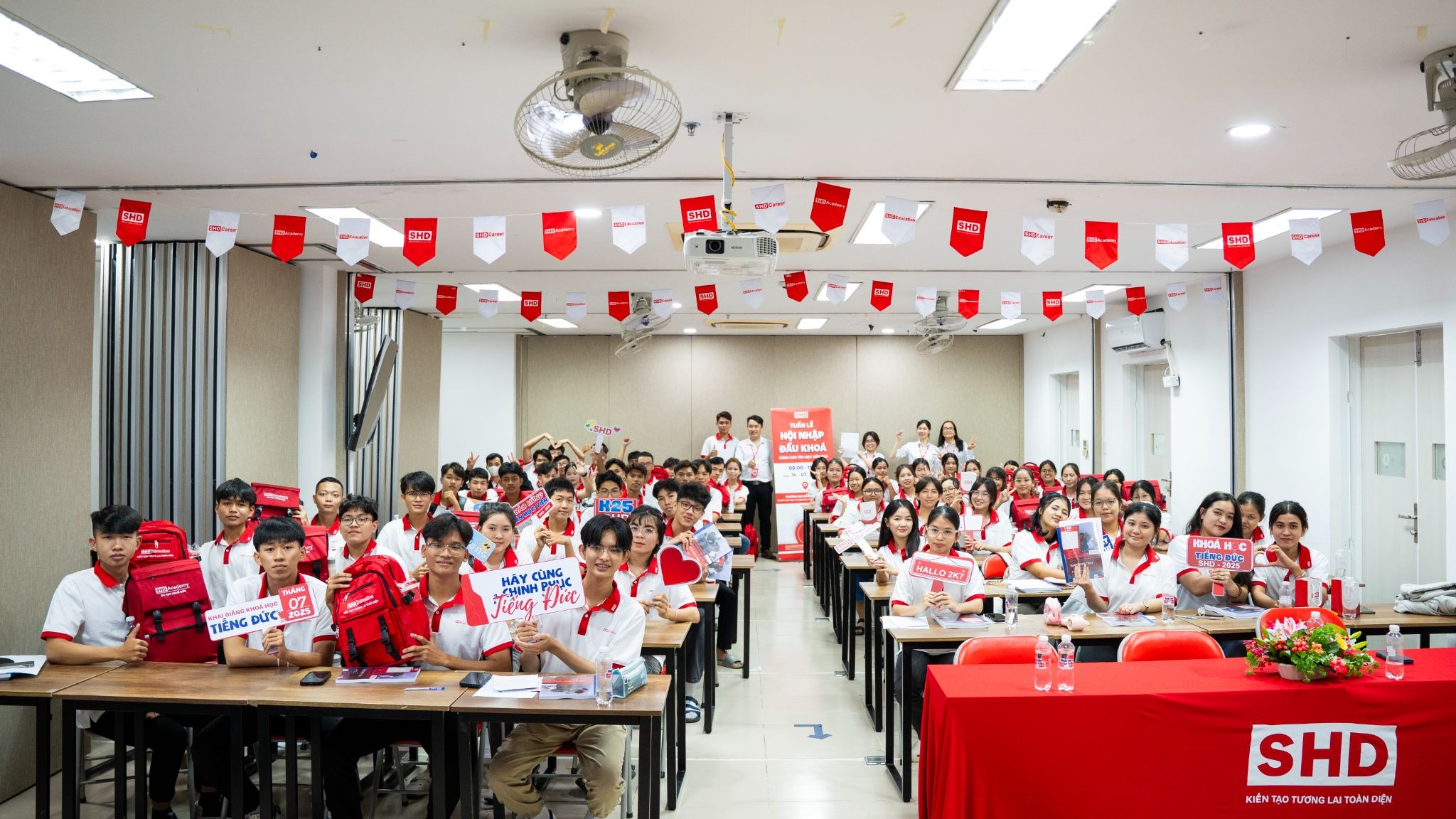
At SHD, students will be fully equipped with knowledge and skills to conquer the ÖSD certificate.
ÖSD is not only a prestigious German language certificate but also a “language passport” that opens up opportunities to study and work in Germany. If you are wondering whether the ÖSD exam is difficult, the answer is: it is difficult to prepare, not difficult if you have the right roadmap.
With a systematic exam preparation program and professional support from SHD Education, students will be fully equipped with knowledge, skills and strategies to effectively conquer the ÖSD certificate. Register today so that SHD can help you build a solid German foundation, help you prepare correctly, sufficiently, and on target, and keep the ÖSD certificate within reach.